

Forensic accounting has always been at the heart of financial investigations — uncovering fraud, tracing illicit funds, and revealing the financial truth behind complex transactions. But the landscape is shifting. Bad actors are increasingly turning to sophisticated technology to conceal criminal activity, and traditional forensic accounting methods are struggling to keep pace.
That’s where AI in forensic accounting comes in. By combining artificial intelligence with deep domain expertise, modern accounting forensics AI platforms can detect patterns, visualize hidden connections, and process millions of transactions in a fraction of the time previously required. The result: faster investigations, higher accuracy, and the ability to surface fraud that would otherwise go undetected.
Below, we explore the key ways AI is revolutionizing forensic accounting — and what that means for legal firms, Chief Compliance Officers (CCOs), CFOs, procurement teams, and financial investigators.
1. Streamlining Data Ingestion and Cleaning
One of the most significant bottlenecks in any forensic accounting investigation is data preparation. On average, preparing data for analysis consumes up to 75% of total investigation time — a staggering proportion that leaves relatively little room for the actual investigative work.
The challenge is substantial. Financial data arrives from a wide variety of sources — bank statements, credit card records, brokerage transaction histories, wire transfer logs — and in an equally wide variety of formats: paper documents, scanned PDFs, CSV exports, and proprietary system outputs. Before any analysis can begin, all of this data must be collected, validated, standardized, and loaded into a single system of record. For investigations involving millions of transactions, this manual work is both time-consuming and error-prone. No wonder the biggest complaint we hear from forensic accountants is that they’re drowning in data.
AI forensic accounting tools solve this problem directly. By automatically scanning documents, identifying key fields (names, dates, account numbers, transaction amounts, currencies), and standardizing everything into a unified, searchable format, AI can reduce data preparation time by up to 90% This represents a fundamental change in how forensic accounting investigations operate, freeing investigators to focus on analysis rather than data wrangling.
2. Automatically Identifying Patterns
Once data is prepared, the real work of accounting forensics AI begins. Finding anomalous transactions within millions of records is, as any experienced investigator knows, like looking for a needle in a haystack. The traditional approach — sorting and filtering across dozens of spreadsheets — is slow, fatiguing, and prone to missing subtle signals.
AI changes the equation by continuously analyzing the entire dataset for statistical outliers, behavioral anomalies, and suspicious patterns. Transactions that deviate from established norms — unusual counterparties and jurisdictions, atypical timing, amounts just below reporting thresholds, rapid round-trip transfers — are automatically flagged for review.
Critically, AI can surface anomalies that even the most experienced forensic accountants might miss during manual review, particularly in large, complex datasets. And the best platforms don’t just flag transactions — they make it easy to drill down, investigate the underlying activity, and build a documented evidentiary trail.
3. Visualizing Complex Connections
Among the most powerful capabilities of AI in forensic accounting is the ability to visualize connections between parties across complex transaction chains. This is particularly valuable for money laundering investigations, where a common technique called layering deliberately routes funds through multiple intermediaries to obscure the relationship between sender and recipient.
Consider a scenario where Person A sends funds to Person B, who passes them to Person C, then to Person D — with each party taking a cut as compensation for participating in the scheme. Tracing that chain manually across thousands of transactions is enormously difficult. Miss one link, and the investigation may stall.
Using AI combined with graph database technology, modern forensic accounting platforms can instantly visualize these multi-hop connections. Investigators can enter the names of two parties and immediately see how they are financially connected, then click through to examine the underlying transactions.
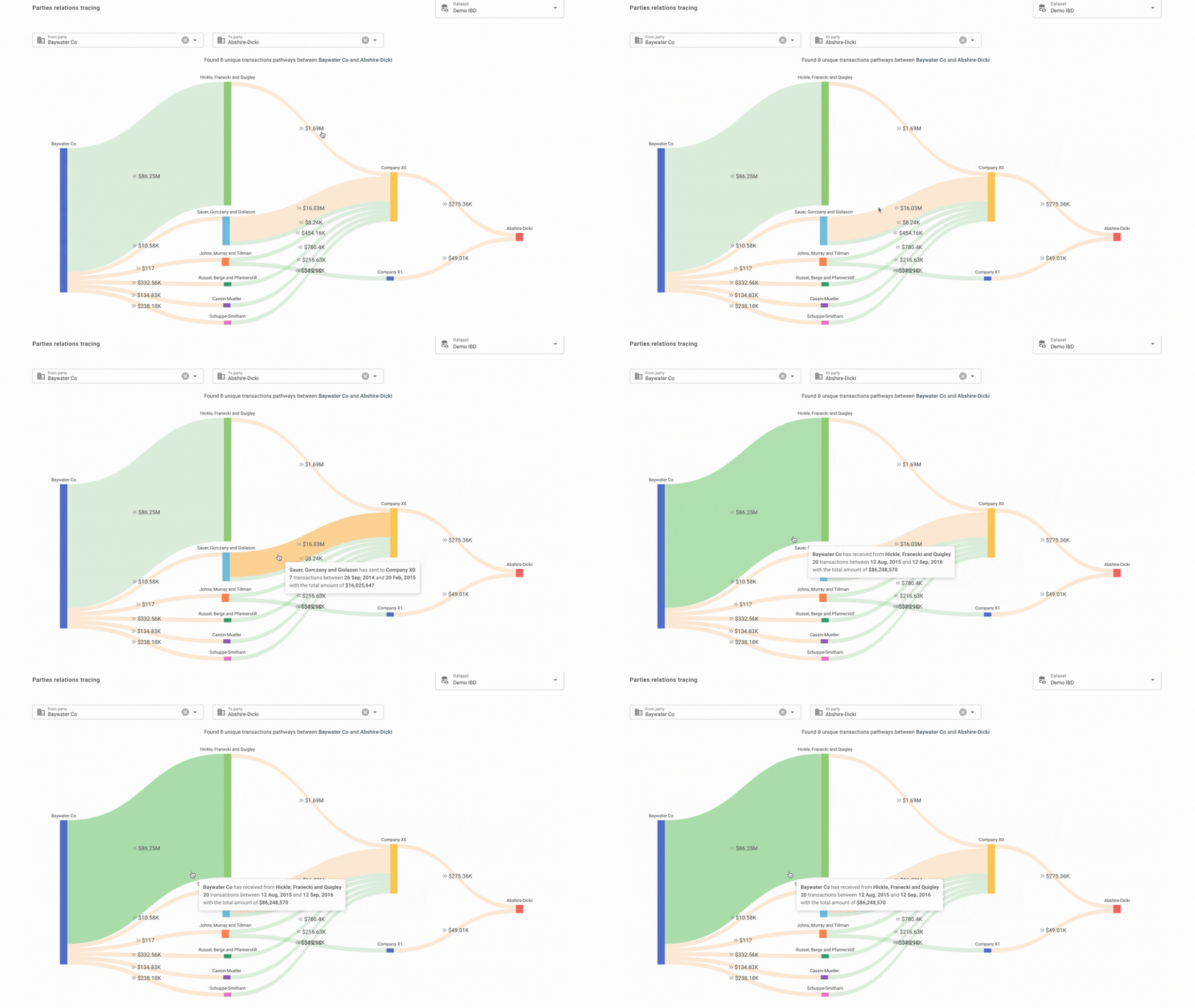
This approach is truly game-changing for financial investigators. As demonstrated in one case study, this capability uncovered 15 additional financial accounts that would have been extremely difficult to find through traditional methods, significantly expanding the scope of the investigation.
4. Enabling Faster, More Thorough Investigations Across Use Cases
The impact of AI forensic accounting tools extends across a wide range of financial crime scenarios
- Fraud investigations: Rapid pattern detection surfaces irregular transactions before losses compound.
- Money laundering: Graph visualization exposes layering schemes and reveals beneficial ownership.
- Embezzlement: AI cross-references internal records to flag unauthorized transfers or altered entries.
- Procurement and construction fraud: AI identifies bid rigging patterns and overbilling schemes across contractor networks.
- Ponzi scheme recovery: AI traces the flow of investor funds to identify recoverable assets and prioritize clawback targets.
- Insider threats: Behavioral analysis detects anomalous activity by employees or executives with system access.
For legal firms, this means stronger, faster case preparation. For CFOs and compliance officers, it means proactive detection rather than reactive damage control. For government investigators, it means the ability to handle larger, more complex cases without proportionally larger teams.
What to Look for in an AI Forensic Accounting Platform
Not all accounting forensics AI tools are created equal. When evaluating platforms, look for these essential features:
- Fast, flexible data onboarding: The platform should be able to ingest financial records from multiple formats and sources — PDFs, CSVs, paper scans, and more — and standardize them within days, not weeks.
- Automated anomaly detection: AI should proactively flag suspicious transactions without requiring investigators to manually define every rule or filter.
- Graph-based connection visualization: The ability to map relationships between parties and trace fund flows through multiple hops is essential for complex financial crime investigations.
- Conversational AI: The tool should allow you to have a conversation with your data so you can get insights by asking open-ended questions or entering detailed prompts.
- Built by domain experts: The most effective platforms are designed by forensic accountants who understand the specific workflows, evidentiary requirements, and investigative challenges of financial crime cases.
Evaluating AI forensic accounting platforms? Sedra Solutions has compiled a comprehensive Financial Investigation Buyer’s Guide with feature checklists to help you assess your options — or contact us to discuss your specific challenges and schedule a demo.
Frequently Asked Questions: AI in Forensic Accounting
What is AI in forensic accounting?
AI in forensic accounting refers to the use of artificial intelligence technologies — including machine learning, natural language processing, and graph databases — to automate and enhance financial investigations. AI forensic accounting tools ingest and standardize large volumes of financial data, automatically detect anomalous transactions, and visualize complex connections between parties: tasks that would take human investigators weeks or months to complete manually.
How does accounting forensics AI detect fraud?
Accounting forensics AI detects fraud by analyzing patterns across millions of financial transactions and automatically flagging outliers that deviate from expected behavior. Unlike traditional manual review, AI can process entire datasets simultaneously, identify layering schemes used in money laundering, and surface hidden connections between parties — even when funds pass through multiple intermediaries specifically designed to obscure the trail.
How much time can AI save in a forensic accounting investigation?
AI can dramatically compress investigation timelines. Data preparation alone — typically the most time-consuming phase, consuming up to 75% of total investigation time — can be reduced by up to 90% with the right AI forensic accounting platform. Analysis that once required weeks of manual spreadsheet review can often be completed in hours or days, significantly lowering both cost and time-to-resolution.
What types of financial crimes can AI forensic accounting tools investigate?
AI forensic accounting tools are effective across a wide range of financial crimes, including fraud, money laundering, embezzlement, Ponzi schemes, procurement fraud, construction fraud, overbilling, bid rigging, and insider threats. They can analyze bank statements, credit card records, brokerage transactions, and other financial data sources to surface suspicious activity regardless of crime type or complexity.
Who benefits from AI in forensic accounting?
A broad range of professionals benefit from AI-driven forensic accounting capabilities: forensic accountants and financial investigators, legal firms and litigation support teams, Chief Compliance Officers (CCOs), Chief Financial Officers (CFOs), internal audit and procurement teams, and government agencies investigating financial crimes. Any organization that needs to analyze large volumes of financial data for signs of fraud or misconduct can benefit from accounting forensics AI.
Can AI replace forensic accountants?
No. AI in forensic accounting is designed to augment human investigators, not replace them. AI handles the time-consuming, error-prone work of data ingestion, standardization, pattern detection, and connection visualization — freeing forensic accountants to focus on higher-level analysis, professional judgment, and investigative strategy. The combination of human expertise and AI capabilities produces faster, more thorough, and more accurate investigations than either can achieve alone.
What should I look for in an AI forensic accounting platform?
The best AI forensic accounting platforms should rapidly ingest and standardize financial data from multiple formats in days rather than weeks; automatically detect anomalous transactions and flag potentially suspicious activity; visualize connections between parties using graph database technology to trace layered money flows; and be purpose-built by forensic accounting experts who understand the specific challenges of financial investigations.
Updated August 18, 2026