
Home → Fraud Examiners → Corruption and Bribery
Corruption and Bribery
The payment looks legitimate. The relationship behind it is the evidence.
Corruption investigations — covering bribery, kickbacks, conflicts of interest, and illicit payments — present a distinctive challenge: the financial evidence often doesn’t look like fraud. Payments are made to real vendors. Money moves through legitimate channels. The misconduct is in the relationship between the parties and the intent behind the transaction, not always in the transaction itself.
Surfacing corruption requires the ability to map relationships, trace payment flows to their ultimate recipients, and identify patterns that reveal undisclosed connections between the people making decisions and the people benefiting from them.
45%
of cases in the ACFE’s 2026 study involved corruption, up from 10% in 1996.
Source: ACFE Occupational Fraud 2026: A Report to the Nations
Why fraud examiners choose Sedra
Key benefits
Vendor and counterparty relationship mapping
Identify undisclosed relationships between employees and vendors, contractors, or other counterparties — including shared addresses, phone numbers, bank accounts, and other links — that may indicate conflicts of interest or kickback arrangements.
Payment pattern analysis
Flag unusual patterns in vendor payments, including sole-source awards to recently established entities, sudden increases in payments to specific vendors, and payments structured in ways that suggest kickback arrangements.
Procurement and contract analysis
Examine contract award patterns, bid processes, and payment histories to identify irregularities that may indicate improper influence over procurement decisions.
Third-party due diligence support
Rapidly analyze the financial history and transaction patterns of third parties under review — distributors, agents, joint venture partners — to identify red flags that warrant escalation or further inquiry.
Cross-jurisdictional tracing
Follow payments across international accounts, currencies, and entities to identify where funds ultimately land and whether there are intermediaries involved.
Defensible findings
Clear, traceable methodology you can present to counsel, regulators, and law enforcement.
Proof from practice

In a related case, Sedra surfaced 15 additional bank accounts across a network of companies.
Related resources


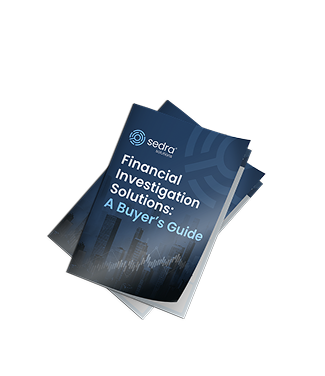
Buyer's guide
Evaluating financial investigation tools?
Our Buyer’s Guide covers how automated solutions address the biggest pain points in financial investigations, the features to look for at every stage from data ingestion to reporting, and best practices for evaluating tools and vendors.
FAQs
Frequently asked questions
How does Sedra find undisclosed relationships between employees and vendors?
Sedra’s Parties Relations Tracing connects parties through shared addresses, phone numbers, bank accounts and other links, including intermediaries and shell entities.
Does Sedra support procurement and bid-rigging investigations?
Yes. Sedra’s Procurement Investigations platform is built to analyze award patterns, bid processes and payment histories for signs of kickbacks and bid rigging.
Can Sedra prove intent or a bribe?
No. Sedra surfaces payment flows and connections. Intent is for the examiner, counsel and the courts to determine.
Fraud examiners
Explore more investigation types
Asset Misappropriation
Asset misappropriation is the most common form of occupational fraud and one of the most difficult to document thoroughly.
Money Laundering
Money laundering investigations require fraud examiners to reconstruct how illicitly obtained funds were introduced into the financial system, moved through layered transactions to obscure their origin, and ultimately integrated into legitimate assets or accounts.
All investigation types
• Corruption and Bribery (this page)