
Home → Fraud Examiners → Money Laundering
Money Laundering
Follow the trail through every layer, entity and jurisdiction.
Money laundering investigations require fraud examiners to reconstruct how illicitly obtained funds were introduced into the financial system, moved through layered transactions to obscure their origin, and ultimately integrated into legitimate assets or accounts. This layering process is deliberately designed to defeat investigation — with each step adding distance between the funds and their source.
Sedra Solutions gives fraud examiners the tools to follow that trail across any number of transactions, entities, and jurisdictions, surfacing the structure of the scheme and building the documented record needed for law enforcement referral, regulatory action, or asset recovery.
Why fraud examiners choose Sedra
Key benefits
Layering and structuring detection
Automatically flag transactions associated with common money laundering techniques, such as structuring payments to avoid reporting thresholds, rapid movement of funds through multiple accounts, unusual cash activity, and circular fund flows that indicate layering.
Shell company and nominee analysis
Map the network of legal entities and nominee accounts used to obscure money flows, tracing funds through complex corporate structures to identify who ultimately controls and benefits from the assets.
Source of funds tracing
Reconstruct the origin of funds by tracing transaction chains backward through the financial system, documenting the link between illicit proceeds and their source.
Multi-jurisdictional, multi-currency investigation
Analyze financial activity across international accounts, currencies, and financial systems without the manual conversion and normalization work that slows traditional investigation. This ability is essential in cases where funds move across borders.
Cash flow reconstruction
Rebuild complete cash flow pictures from fragmented or incomplete records, identifying gaps in the documented transaction chain that may indicate unreported financial activity.
Screening
Screen parties in the dataset against Politically Exposed Persons (PEP), Sanctions, and Debarment lists.
Proof from practice

In an embezzlement and money laundering case, Sedra surfaced 15 additional bank accounts across a network of companies.
Related resources


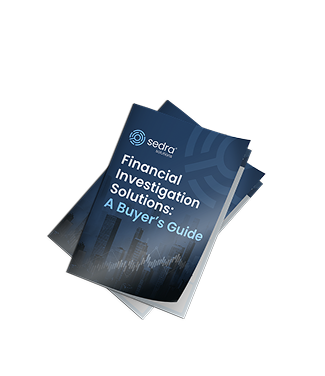
Buyer's guide
Evaluating financial investigation tools?
Our Buyer’s Guide covers how automated solutions address the biggest pain points in financial investigations, the features to look for at every stage from data ingestion to reporting, and best practices for evaluating tools and vendors.
FAQs
Frequently asked questions
How does Sedra detect layering and structuring?
Sedra flags patterns associated with common laundering techniques, including payments structured below reporting thresholds, rapid movement through multiple accounts, and circular fund flows.
Can Sedra trace funds across currencies and jurisdictions?
Yes. Sedra analyzes activity across international accounts and currencies without the manual conversion and normalization work that slows traditional investigations.
Does Sedra file Suspicious Activity Reports?
No. Sedra helps you trace and document the flow of funds; SAR filings are prepared by the appropriate parties.
Fraud examiners
Explore more investigation types
Ponzi Schemes and Investment Fraud
Ponzi schemes and investment fraud cases generate some of the most complex financial data environments fraud examiners encounter.
Corruption and Bribery
Corruption investigations — covering bribery, kickbacks, conflicts of interest, and illicit payments — present a distinctive challenge: the financial evidence often doesn’t look like fraud.
All investigation types
→ Ponzi Schemes and Investment Fraud
• Money Laundering (this page)