
Home → Fraud Examiners → Financial Statement Fraud
Financial Statement Fraud
Look beyond the reported numbers to the data underneath.
Financial statement fraud — the deliberate misrepresentation of an organization’s financial condition — tends to be among the most damaging and most difficult fraud schemes to uncover. Unlike asset misappropriation, where transactions leave a direct trail, financial statement fraud often involves manipulation of what is recorded and how, making anomalies visible only when the reported figures are compared against underlying transaction data, industry benchmarks, or prior periods at scale.
Sedra Solutions enables fraud examiners to move beyond the reported numbers and interrogate the underlying data, surfacing the discrepancies, patterns, and relationships that reveal manipulation.
6%
of cases in the ACFE’s 2026 study involved financial statement fraud, but with a $1 million median loss, the most costly category.
Source: ACFE Occupational Fraud 2026: A Report to the Nations
Why fraud examiners choose Sedra
Key benefits
Revenue and expense analysis
Compare reported financial results against underlying transaction data to identify inflated revenues, understated expenses, and fictitious entries that distort the true financial picture.
Journal entry examination
Analyze large volumes of journal entries to flag unusual posting patterns — entries made outside normal business hours, by unexpected users, with round numbers, or that bypass standard approval workflows — all common indicators of deliberate manipulation.
Multi-period trend analysis
Identify statistical anomalies and inconsistencies across reporting periods that may indicate earnings management, revenue smoothing, or the gradual manipulation of key financial metrics.
Related-party transaction scrutiny
Map and analyze transactions between the subject entity and related parties — subsidiaries, affiliates, executives, and their associates — to identify undisclosed relationships and transactions that may be distorting reported results.
Inventory and asset verification support
Trace the movement of inventory and fixed assets through financial records to identify fictitious assets, inflated valuations, and discrepancies that indicate manipulation of the balance sheet.
Benchmark and ratio analysis
Compare financial ratios and key metrics against industry peers, prior periods, and internal benchmarks to identify statistical outliers that warrant deeper investigation.
Proof from practice

It shows up when reported figures are compared to underlying data across periods, entities and related parties. Sedra standardizes that data so the comparison starts in days, not weeks.
Related resources


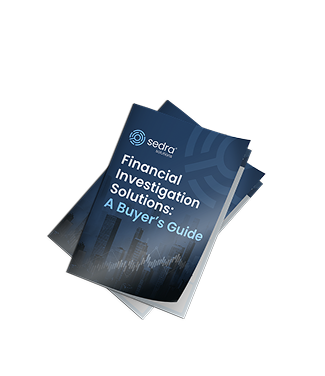
Buyer's guide
Evaluating financial investigation tools?
Our Buyer’s Guide covers how automated solutions address the biggest pain points in financial investigations, the features to look for at every stage from data ingestion to reporting, and best practices for evaluating tools and vendors.
FAQs
Frequently asked questions
How does Sedra support journal entry testing?
Sedra lets you analyze large volumes of journal entries and flag unusual patterns such as off-hours postings, unexpected users, round amounts, and entries that bypass normal approval.
Can Sedra help identify undisclosed related-party transactions?
Sedra maps transactions between the subject entity and related parties, including subsidiaries, affiliates, executives and their associates, so undisclosed relationships become visible.
Does Sedra determine whether fraud occurred?
No. Sedra surfaces discrepancies and relationships. The examiner evaluates them and reaches the conclusion.
Fraud examiners
Explore more investigation types
Asset Misappropriation
Asset misappropriation is the most common form of occupational fraud and one of the most difficult to document thoroughly.
Money Laundering
Money laundering investigations require fraud examiners to reconstruct how illicitly obtained funds were introduced into the financial system, moved through layered transactions to obscure their origin, and ultimately integrated into legitimate assets or accounts.
All investigation types
• Financial Statement Fraud (this page)