
Home → Fraud Examiners → Ponzi Schemes and Investment Fraud
Ponzi Schemes and Investment Fraud
Reconstruct years of commingled funds and thousands of investors.
Ponzi schemes and investment fraud cases generate some of the most complex financial data environments fraud examiners encounter. Investor funds are commingled, recycled as fictitious returns, diverted for personal use, and moved through layered entities — often across years of activity involving hundreds or thousands of investors. Reconstructing what actually happened, identifying the money trails, and identifying where assets went requires the ability to analyze data at a scale and speed that manual methods simply cannot achieve.
Sedra Solutions automates the most labor-intensive aspects of Ponzi scheme investigation, enabling fraud examiners to reach findings faster and with the rigor that asset recovery proceedings demand.
Why fraud examiners choose Sedra
Key benefits
Investor fund tracing
Track the movement of investor contributions from point of receipt through every subsequent transfer, disbursement, and commingling event. The result is a complete documented picture of how funds moved through the scheme.
Fund commingling analysis
Identify instances where investor funds were commingled with operator funds or used for personal expenditures, documenting the diversion of assets away from their intended investment purpose.
Entity and account mapping
Visualize the full network of entities, bank accounts, and individuals involved in the scheme, including nominee accounts, shell companies, and intermediary entities used to obscure the flow of funds.
Asset location support
Trace diverted funds to identify assets available for recovery, including real estate, investment accounts, business interests, and other property purchased with misappropriated investor money.
Scalable analysis across large datasets
Process the full transaction history of complex, multi-year schemes involving thousands of investor accounts and millions of transactions — without the bottlenecks that manual analysis creates.
Proof from practice

In a Sedra case study, a five-analyst team spent roughly 550 hours on data collection, organization and standardization. With Sedra, that work took about 56 hours, a 90% reduction.
Related resources


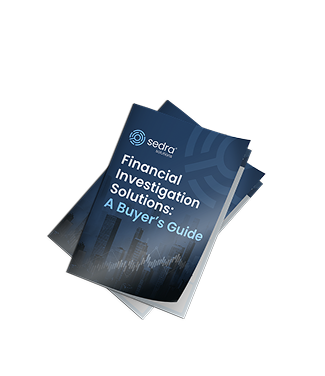
Buyer's guide
Evaluating financial investigation tools?
Our Buyer’s Guide covers how automated solutions address the biggest pain points in financial investigations, the features to look for at every stage from data ingestion to reporting, and best practices for evaluating tools and vendors.
FAQs
Frequently asked questions
How does Sedra help with Ponzi scheme recovery?
Sedra automatically ingests and prepares data for analysis, surfaces anomalies and suspicious patterns, and helps examiners identify hidden connections and intermediaries that were used to obscure the flow of funds.
Can Sedra handle multi-year schemes with millions of transactions?
Yes. Sedra processes the full transaction history of large, multi-year schemes without the bottlenecks of manual analysis.
Can Sedra help locate assets for recovery?
Sedra traces diverted funds to the accounts and assets they reached, which supports the examiner’s asset location work.
Fraud examiners
Explore more investigation types
Money Laundering
Money laundering investigations require fraud examiners to reconstruct how illicitly obtained funds were introduced into the financial system, moved through layered transactions to obscure their origin, and ultimately integrated into legitimate assets or accounts.
Asset Misappropriation
Asset misappropriation is the most common form of occupational fraud and one of the most difficult to document thoroughly.
All investigation types
• Ponzi Schemes and Investment Fraud (this page)